Super duplex 2507 fasteners are engineered for demanding industrial applications where conventional stainless steel may not provide sufficient resistance to chloride-induced corrosion or adequate mechanical performance. Commonly identified as UNS S32750 or EN 1.4410, super duplex 2507 combines a mixed ferritic-austenitic microstructure with high chromium, molybdenum, and nitrogen content.
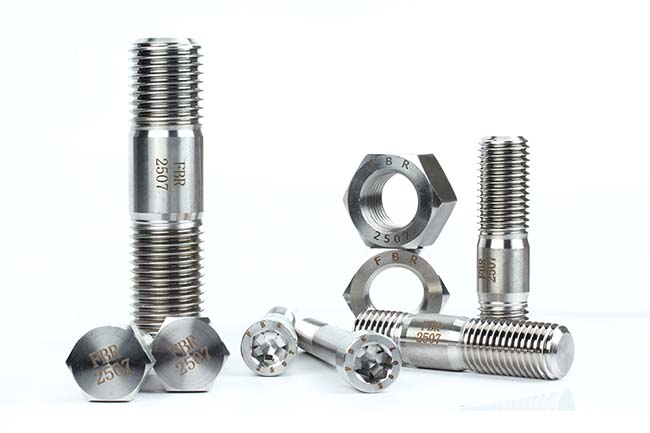
For engineers and purchasing teams, 2507 is particularly relevant to offshore, marine, desalination, chemical processing, oil and gas, and other highly corrosive applications. However, selecting 2507 should be based on actual service conditions, the required fastener specification, mechanical properties, manufacturing requirements, and inspection documentation rather than simply choosing the most corrosion-resistant material available.
What Are Super Duplex 2507 Fasteners?
Super duplex 2507 fasteners are bolts, screws, nuts, studs, threaded rods, washers, or custom components manufactured from super duplex stainless steel UNS S32750.
The alloy typically contains approximately 25% chromium, 7% nickel, 4% molybdenum, and nitrogen. This composition supports a microstructure containing both ferrite and austenite and provides significantly stronger resistance to localized corrosion than many conventional austenitic stainless steels.
For projects requiring special corrosion-resistant alloys, buyers can review the particular materials fasteners category for additional material and product options.
Why Is Super Duplex 2507 Used for Fasteners?
Fasteners can be particularly vulnerable in corrosive systems because threaded connections create geometries where moisture, salts, and process fluids can accumulate. Crevices beneath bolt heads, nuts, washers, and thread interfaces may create conditions that differ from exposed surfaces.
Super duplex 2507 is selected when an application requires a combination of:
- High resistance to chloride-induced pitting
- Strong resistance to crevice corrosion
- Good resistance to chloride stress corrosion cracking
- Higher mechanical strength than common austenitic stainless steels
- Resistance to many aggressive industrial environments
These characteristics make super duplex fasteners valuable for equipment where corrosion-related fastener failure could increase maintenance, replacement, or shutdown costs.
Super Duplex 2507 vs 316 Stainless Steel Fasteners
316 stainless steel is widely used for general corrosion-resistant fastening, but severe chloride exposure can challenge its resistance to localized corrosion. Super duplex 2507 contains substantially higher chromium and molybdenum levels together with nitrogen, providing a much stronger material option for many aggressive chloride environments.
| Factor | 316 Stainless Steel | Super Duplex 2507 |
|---|---|---|
| Material family | Austenitic stainless steel | Ferritic-austenitic super duplex stainless steel |
| Common designation | UNS S31600 / S31603 for 316 / 316L | UNS S32750 |
| Chloride pitting resistance | Suitable for many moderate environments | Significantly higher for severe chloride exposure |
| Crevice corrosion resistance | Moderate depending on conditions | Higher in many aggressive environments |
| Mechanical strength | Suitable for many general applications | Generally substantially higher |
| Typical application level | General industrial, food, water and marine-related equipment | Offshore, desalination, chemical and severe marine service |
| Relative material cost | Generally lower | Generally higher |
316 remains an appropriate and economical material for many applications. Super duplex 2507 should not replace 316 automatically when the service environment does not require its additional performance. Buyers evaluating less severe environments can also review 304 vs 316 stainless steel fasteners.
Super Duplex 2507 vs Duplex 2205 Fasteners
Duplex 2205 and super duplex 2507 both contain ferritic and austenitic phases, but 2507 is more highly alloyed. Its higher chromium, molybdenum, and nitrogen content generally provides better resistance to pitting and crevice corrosion, especially in chloride-rich conditions.
Duplex 2205 may be sufficient for many chemical, water treatment, structural, and industrial applications. Super duplex 2507 becomes more attractive when chloride concentration, temperature, seawater exposure, or corrosion consequences make 2205 inadequate.
The correct selection should therefore be based on corrosion data and service conditions rather than assuming that the higher-alloy material is necessary for every project.
Standards and Material Designations for 2507 Fasteners
UNS S32750 and EN 1.4410 are widely recognized designations for super duplex 2507. Buyers should distinguish between a material designation, a raw-material specification, and a finished-fastener specification.
ASTM A479, for example, can be relevant to stainless steel bar products from which certain machined components may be produced. ASTM A182 Grade F53 is associated with UNS S32750 forgings. ASTM A1082/A1082M addresses high-strength precipitation-hardening and duplex stainless steel bolting for special-purpose applications.
These standards are not automatically interchangeable. The engineering drawing or purchase specification should identify which standard applies to the finished product and which requirements apply to the starting material.
Dimensional standards such as DIN or ISO product standards may separately define bolt geometry, thread length, head dimensions, or other features. A dimensionally compliant bolt does not automatically confirm compliance with a particular material or mechanical specification.
Common Types of Super Duplex 2507 Fasteners
Depending on the application and manufacturing requirements, S32750 can be specified for several fastening configurations:
- Hex bolts and heavy-duty bolts
- Socket head screws
- Stud bolts
- Double-end studs
- Fully threaded rods
- Hex nuts and heavy hex nuts
- Washers
- Drawing-based custom fasteners
Standard and custom industrial bolts may require different dimensional, thread, and material specifications depending on the equipment design.
For flange connections, pressure equipment, and process systems, stud bolts and threaded rods are also common fastening formats.
Applications for Super Duplex 2507 Fasteners
Marine and Offshore Equipment
Seawater contains chlorides that can cause localized corrosion in less resistant stainless steels. Super duplex 2507 fasteners may be specified for offshore structures, seawater systems, marine equipment, and other assemblies exposed to aggressive saltwater conditions.
Desalination and Water Treatment
Desalination equipment can involve concentrated chloride environments. Bolts, studs, nuts, and other fastening components used around pumps, piping, filtration systems, and related equipment may require super duplex materials depending on the operating conditions.
Oil and Gas Systems
Super duplex fasteners can be used in offshore production systems, processing equipment, valves, pumps, piping connections, and related installations. Where hydrogen sulfide is involved, material selection must also consider the applicable sour-service requirements rather than relying solely on the S32750 grade name.
Chemical and Petrochemical Processing
Process equipment may expose fasteners to chlorides, acids, elevated temperatures, or combinations of corrosive media. Super duplex 2507 can be considered where corrosion evaluation demonstrates that conventional stainless steels are insufficient.
Pumps and Valves
Bolting around pumps and valves may encounter both mechanical loading and corrosive process fluids. Material compatibility between fasteners and the connected equipment should be reviewed to control corrosion and maintain reliable assembly performance.
Manufacturing Super Duplex Fasteners Requires Care
The properties of super duplex stainless steel depend not only on chemical composition but also on processing history and microstructure. Excessive or poorly controlled thermal exposure can affect phase balance and lead to undesirable intermetallic phases, potentially reducing corrosion resistance and toughness.
For this reason, buyers should clearly communicate manufacturing, heat-treatment, testing, and documentation requirements when they are specified by the applicable standard or project documentation.
Machining can also be more demanding than machining common austenitic stainless steels because of the material's higher strength and work-hardening behavior. Custom dimensions, special threads, tight tolerances, and complex geometries should therefore be defined clearly before quotation.
Do Super Duplex 2507 Fasteners Need a Coating?
Super duplex 2507 is normally selected for the corrosion resistance of the base alloy itself, so conventional protective metallic coatings are not automatically required.
However, surface condition, cleaning, passivation requirements, lubrication, or special assembly treatments may still be specified according to the application. Any coating or lubricant should be evaluated for compatibility with the fastener material, service environment, installation torque requirements, and customer specification.
Procurement Checklist for Super Duplex 2507 Fasteners
Because super duplex components are often used in critical applications, an RFQ should contain enough information to avoid ambiguous substitutions. Buyers should normally specify:
- Material designation, such as UNS S32750 / EN 1.4410
- Fastener type and applicable dimensional standard
- Finished-fastener or material specification where required
- Diameter, length, and thread pitch
- Metric, UNC, UNF, or other thread system
- Thread tolerance and critical dimensions
- Required mechanical properties
- Surface condition, passivation, or lubricant requirements
- Operating environment and relevant corrosive media
- Inspection and testing requirements
- Required material and inspection documentation
- Order quantity and packaging requirements
For custom components, the inquiry should also include a controlled 2D drawing or 3D model identifying critical dimensions, tolerances, head geometry, drive type, thread engagement, and any special manufacturing requirements.
When Should You Consider an Alternative Alloy?
Super duplex 2507 provides excellent performance in many chloride-rich environments, but it is not a universal corrosion solution. Certain combinations of acids, temperatures, reducing environments, or specialized chemical media may require nickel-based alloys, titanium, or another engineered material.
For example, projects involving severe chemical exposure may also evaluate products such as Hastelloy C276 threaded rods. Material selection should be based on the actual process environment and engineering requirements rather than a simple ranking of alloy grades.
Selecting Super Duplex 2507 Fasteners for B2B Projects
Super duplex 2507 fasteners are a strong option when industrial assemblies require high mechanical performance together with excellent resistance to pitting, crevice corrosion, and chloride stress corrosion cracking. Their main application areas include offshore, marine, desalination, oil and gas, chemical processing, and other highly corrosive systems.
For procurement teams, the most important step is to specify more than the material name. The RFQ should combine UNS S32750 with the correct product standard, dimensions, threads, mechanical requirements, inspection criteria, documentation, and application conditions.
IIIBEAR supplies standard and custom fasteners for industrial projects requiring stainless steel, super duplex, nickel alloys, titanium, and other specialized materials according to project specifications and drawings.
Related products: Special Material Fasteners

